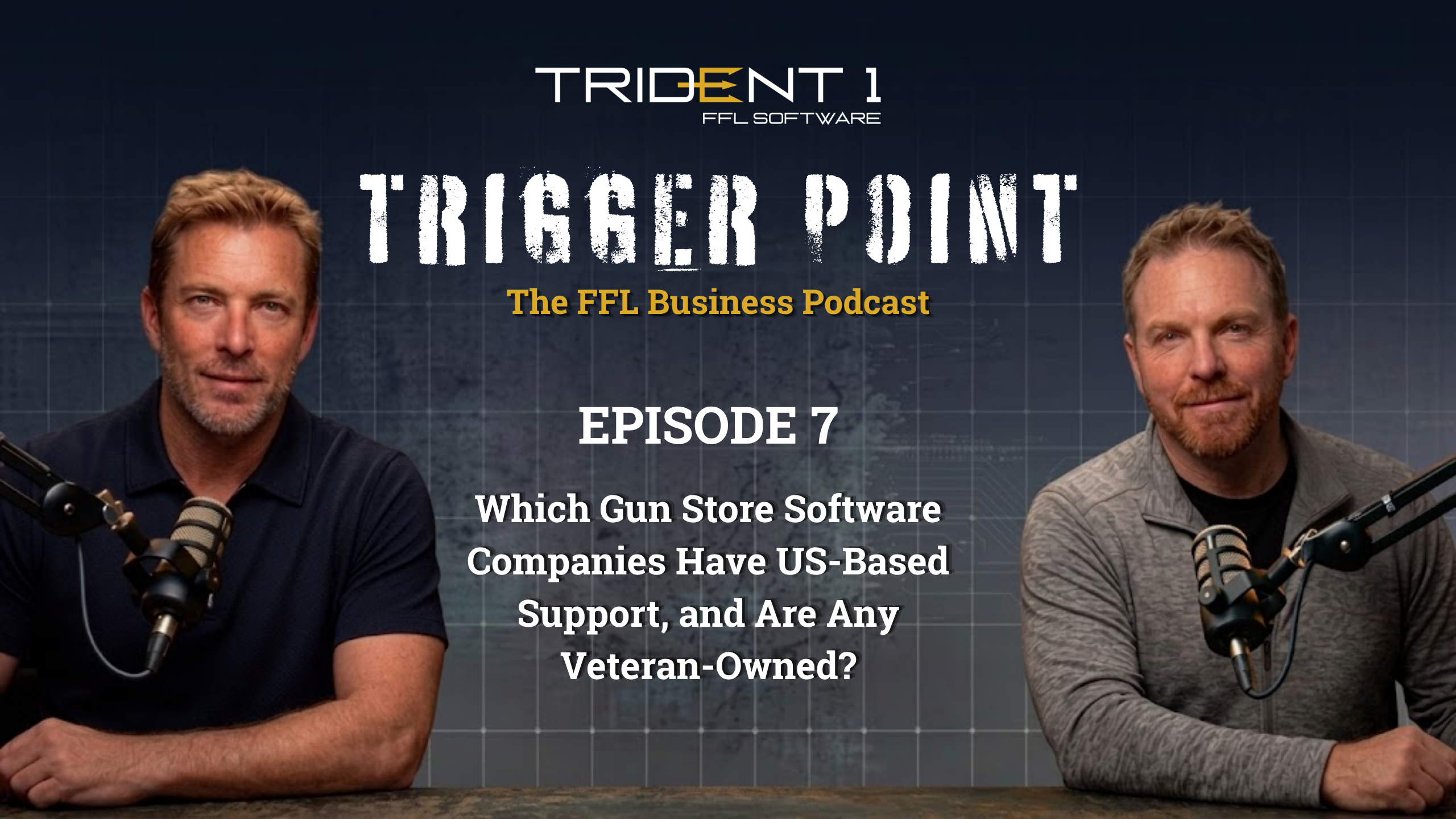

For FFL dealers, software support matters most when a problem affects a live transaction, inventory, or a compliance-related workflow. In this episode of Trigger Point, host Kevin Wosmansky talks with Jake Newbold of Trident 1 FFL Software about what happens when you call FFL software support, why U.S.-based help matters, and how Trident 1’s veteran-owned culture shapes its service. The main takeaway is that dealers should evaluate support just as carefully as features, pricing, and integrations when choosing a POS system.
A software issue at a gun store can create more than a simple inconvenience. FFLs operate in a regulated environment where transactions, firearm records, serialized inventory, and transfers must be handled correctly.
The Bureau of Alcohol, Tobacco, Firearms and Explosives makes clear that FFLs are responsible for maintaining accurate records and following federal requirements.
That makes knowledgeable support especially valuable.
Newbold says Trident 1 hires support staff with real firearms-industry experience. Team members have backgrounds in gunsmithing, gun store management, shooting ranges, military service, and law enforcement.
“When a customer or dealer calls with an issue, they’re talking to somebody with experience who has probably faced the same issues they’re having,” Newbold says.
That familiarity can make troubleshooting faster because the support team already understands the terminology and workflows involved.
Newbold says Trident 1 treats customer service as a core part of the business because software problems can quickly affect sales.
A customer may be standing at the counter ready to complete a high-value purchase when something stops working. In that situation, waiting days for a support ticket is not ideal.
Trident 1’s approach is centered on live phone support. Dealers can call and speak with a U.S.-based representative who can help diagnose the issue. In some cases, the team can remotely access the system and correct the problem directly.
Newbold says many issues are relatively simple, such as a user forgetting how to perform a certain function. Still, the priority is to resolve the problem as quickly as possible.
He estimates that about 90 percent of issues can be handled during the initial interaction.
Newbold is a retired Navy SEAL who served more than 20 years on active duty. He says that background strongly influenced how he built Trident 1.
The company employs a large number of military veterans and law enforcement professionals. Newbold estimates that more than 80 percent of the team has a veteran background.
The U.S. Small Business Administration also recognizes veteran-owned businesses through dedicated programs and certification resources.
At Trident 1, Newbold says veteran ownership affects hiring, communication, urgency, and problem-solving.
He also stresses that military experience is not required to provide good customer service. The advantage, in his view, is having people who understand firearms culture and can relate to gun store owners, range staff, RSOs, and other industry professionals.
Trident 1 serves customers across multiple U.S. time zones, including Alaska and Hawaii. Because of that, Newbold says the company tries to keep support available during the hours its retail customers are open.
He also notes that the team has handled issues during holidays when necessary.
The development staff works across different shifts as well. That allows some technical problems to be addressed overnight while a dealer is closed, which can reduce disruption during business hours.
For dealers comparing software companies, this makes support hours an important question. It is worth asking who answers the phone, what happens after normal hours, and how quickly technical issues are escalated.
FFL dealers often focus first on POS features, integrations, inventory tools, and pricing. Support should be part of that same evaluation.
Before choosing a platform, dealers should understand who provides support, whether that team understands the firearms industry, how easy it is to reach a real person, and how urgent problems are handled.
Software also does not replace the dealer’s own compliance responsibilities. FFLs remain responsible for meeting applicable federal recordkeeping and regulatory requirements.
That is why what happens when you call FFL software support should be answered before a dealer signs up for a system, not after the first major problem occurs.
Yes. Jake Newbold describes Trident 1 as a veteran-owned and veteran-run company with many military and law enforcement professionals on staff.
Yes. According to Newbold, Trident 1 provides live U.S.-based customer support.
Yes. Team members have backgrounds that include gunsmithing, gun store management, shooting ranges, military service, and law enforcement.
In some cases, yes. Newbold says the support team can remotely access a customer’s system when needed.
No. Dealers remain responsible for following applicable federal laws, regulations, and recordkeeping requirements.
Ask about response times, support hours, escalation procedures, industry experience, live phone access, and whether technical help is available across different time zones.
Newbold says the company tries to provide coverage based on customer operating hours across different U.S. time zones and has handled urgent issues outside normal hours when necessary.
Kevin Wosmansky: Hey, welcome back to the next episode of Trigger Point. I’m here today with Mr. Jake from Trident 1 FFL Software. How’s it going, Jake?
Jake Newbold: Good, Kevin. How are you, buddy?
Kevin Wosmansky: Good, man. Good to see you. It’s summer here, and it’s been a little while. Everybody’s been taking some vacation time, so it’s good to get back with you.
Jake Newbold: Yes, sir. I’m just trying not to melt here in Dallas.
Kevin Wosmansky: Yeah, we’re seeing hundred-degree-plus weather daily, too. Come out to Iowa. It’s not a whole lot better here, so I think it’s nationwide.
Hey, I have a great question here that some customers and prospects have been asking. Today’s topic is this: Jake, who actually has U.S.-based support in the FFL point-of-sale system space, and is Trident 1 veteran-owned?
Jake Newbold: Oh, yeah. That’s a great question. Obviously, I’m pretty biased because I’m a retired Navy SEAL. I spent over 20 years on active duty, and that’s my DNA.
So instead of trying to work outside my DNA, I built a team that is largely made up of veterans and law enforcement. To answer your second question, yes, Trident 1 is veteran-owned. We’re run by, I think, five former Navy SEALs. We have a little squad going on.
We have seven or eight SEALs on board and just hired another one not long ago. Across the spectrum, as far as veterans go, we have Marines, Army, and Air Force. I think the only one we don’t have yet is Coast Guard. So, if there are any Coast Guard folks out there—
Kevin Wosmansky: And Space Force, Jake.
Jake Newbold: Space Force, yeah. Space Force.
Probably over 80 percent of our team is veterans, along with some law enforcement as well. We have three or four former police officers. One is actually still active on a drug task force SWAT team.
Veterans are obviously near and dear to my heart. We are largely a veteran-owned and veteran-run company, which makes sense. If you’re working in the firearms industry, why not have people who are aware, useful, and know guns?
I’m not saying they’re gun dealers or that they know better than our customers. That’s definitely not the case. But they definitely relate well, especially to the ranges out there, the range safety officers, and others in the firearms industry.
What we’ve seen is that a lot of veterans are in this space. If they don’t own the gun store, many of them work at gun stores. So it works well for us.
The first part of the question was about U.S.-based customer support. I think this is one of the things that really separates us from our competitors. We have a lot of good competitors in the space, and everybody is doing what they can to support the retailer, but we are one of the few that has true U.S.-based customer support.
Not only are they living in the United States, but when I hire our customer support team, I make sure they have experience in the firearms industry. We have a guy who has an associate degree in gunsmithing and is a gunsmith. Another one of our guys was a manager at two different gun stores and shooting ranges.
When a customer or dealer calls with an issue, they’re talking to somebody with experience who has probably faced the same issues they’re having and can walk them through how to fix it. I think that’s pretty critical.
Kevin Wosmansky: When we ask why U.S.-based customer support matters more for an FFL than a typical retail business, obviously in this business, you have to have people who understand not just firearms and the firearms industry, but also the culture. That means a lot.
So let me ask you this: What does being veteran-owned actually change about how the company operates day to day?
Jake Newbold: It shapes hiring and culture in a way that shows up in how the team understands the operational reality of running an FFL. The stakes of an ATF compliance question aren’t abstract to a team with that type of background.
I’m not saying people outside the U.S. can’t be trained or can’t be great customer support reps. That’s not the case whatsoever. But when it comes to a compliance-led industry where your license, livelihood, and money are on the line, and you have a lot invested in it, you probably want somebody on the support side who actually knows what they’re talking about.
Especially if it’s compliance-related, that’s nothing to mess around with. Communication is a big thing, too. Your customer needs to understand you. You can’t play the telephone game when it comes to customer support in the gun industry.
Kevin Wosmansky: Absolutely.
Jake, walk me through what happens when one of your customers, a gun store, calls in with an urgent issue. I think this is something that a lot of people looking for a new point-of-sale system care about. It’s a big deal. They don’t need you until they really need you.
Jake Newbold: It’s ingrained in our mission statement. The final part is that we provide legendary customer service, and I 100 percent believe that one of the most important things for Trident 1, if not the most important thing, is to provide legendary customer service.
When somebody calls in, if they’re calling their point-of-sale company, their software company that runs their whole store, there’s probably a big problem. They might have a sale held up at the counter. If they can’t get it fixed, they might lose a $2,500 sale.
They need an answer right now. They don’t need it to go to voicemail. They don’t need to have to submit a ticket. They call our customer support number, and we have live, U.S.-based, very well-trained people who are well-versed in the industry pick up the phone and walk them through the issue.
Sometimes we can remote into their system and fix the problem for them. Usually, it’s something like a customer forgot how to use a certain function, but the bottom line is that a U.S.-based person is going to pick up the phone and help them fix the issue.
Some things are beyond our control, but chances are we’ve seen the issue before. Our support team is very well-versed in this. Again, a lot of them have industry experience, and they’ve probably faced the same issue themselves.
Rather than routing someone through a ticket system with a multi-day queue, 90 percent of the time we can fix the issue right there, and that’s huge. I think that’s what customers want. If they have an issue, they want to pick up the phone and call somebody who is in the same time zone, or at least on the same continent, and more importantly, someone who understands firearms and the industry. I think that’s pretty critical.
Kevin Wosmansky: So, Jake, while we’re on this, what are the actual support hours and typical response times for Trident 1?
Jake Newbold: We try to cover everything. We have customers, I think, in all 50 states, including Hawaii and Alaska, so that means multiple time zones.
My support guys would kill me for saying this, but they’re really on call. We’ve dealt with things on Christmas Day for hours, Christmas Eve, you name it.
We try to have guys and gals in different time zones who are available when our customers are open. That’s when customers are going to have issues.
Our development team also works in shifts. We have people who work at night and people who work during the day. If something needs to be done overnight while the retailer is closed, we can knock it out before they open back up.
To answer your question, we like to have at least some of our support team available during the operating hours of our retail customers. It’s kind of a nine-to-five type of thing, but we take different time zones into consideration. California is different from New York, for example.
Kevin Wosmansky: Absolutely.
All right, great answer. Last question here, and then we’ll wrap this up. Jake, is being veteran-owned just a badge, or does it actually show up operationally at Trident 1?
Jake Newbold: No, it definitely shows up. It shows up in our hiring practices and in how the team talks to owners about compliance and urgency. It’s a verifiable claim, not a marketing line, and any owner can test it by calling in.
I would add, Kevin, that this is such a great topic. I would encourage folks who are looking for a system, looking to make a change to their software system, point-of-sale system, range management system, or who are just getting into the industry, to really dig into these questions when they are vetting systems and companies that are going to run their whole business and help keep them compliant.
I would ask these types of questions because it really does make a difference to have people who understand the firearms industry. I’m obviously not knocking non-veterans, but like I said, many of our customers have veterans working at the sales counter, as RSOs, or in other roles. It’s easy for our team to relate to them.
Again, I would encourage people to ask these questions when they’re vetting and trying to decide who to go with. U.S.-based customer support is massive for Trident 1. You want to make sure you have a reliable customer service support team. You don’t want to talk to an AI chatbot or have to submit a ticket. You want to pick up the phone, call, and talk to a real person who can help you with your issue.
Kevin Wosmansky: That’s a perfect answer and a great way to wind it down, Jake.
I think it’s really important that people asking these questions get the right information. Trident 1 has U.S.-based support. Trident 1 is a veteran-owned business, and Trident 1 is best in class for federal firearms licensing point-of-sale systems.
I really appreciate you explaining all that and laying it out for us. It’s great seeing you again, Jake. Thanks for jumping on with me for a little bit here, and don’t sweat too much in that Texas heat, all right?
Jake Newbold: You got it, Kevin. Take care. I appreciate you.
Kevin Wosmansky: Have a good one, man.
Jake Newbold: You as well. Thank you.
Unlock the potential of your gun store or range with Trident 1. Book a call now and discover how our team can tailor unique solutions to meet your specific needs.