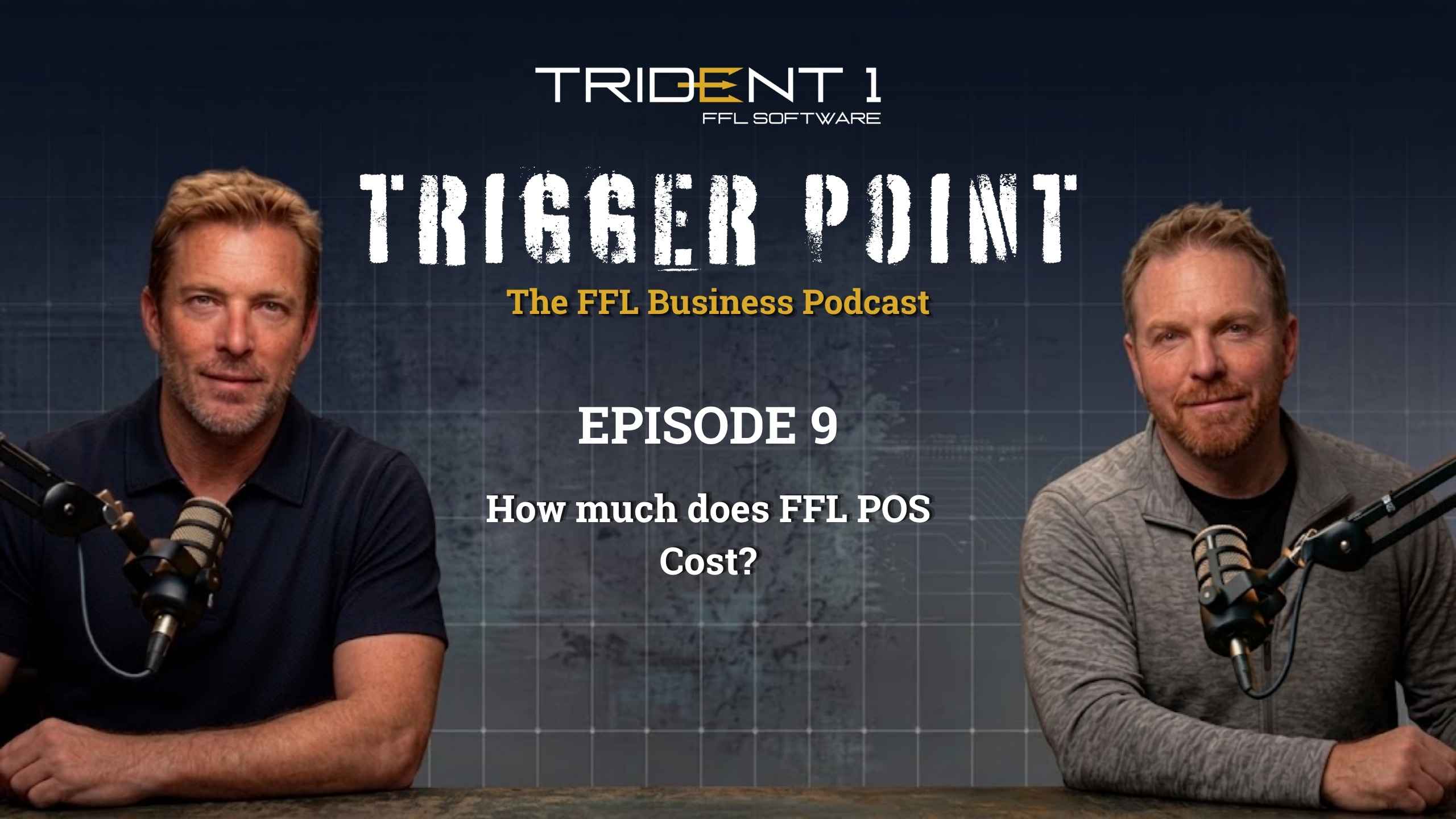

In this episode of Trigger Point, the FFL Business Podcast, host Kevin sits down with Jake Newbold and Daniel Peterson to answer one of the biggest questions gun store and range owners ask: what is Trident 1 POS, and why was it built specifically for the firearms industry? The answer comes down to a few core takeaways.
Trident 1 FFL Software was created to replace outdated, expensive, server-based systems with a modern cloud platform. It was built around compliance, profitability, mobility, and day-to-day operational control. Most importantly, it was designed only for FFLs, not adapted from generic retail software. For dealers looking for FFL dealer software that understands the realities of firearms retail, this episode lays out exactly why Trident 1 exists.
Jake Newbold describes Trident 1 FFL Software as “a veteran-run, veteran-built, largely special operations-driven, cloud-based software platform designed specifically and only for federal firearms licensees.”
That matters.
Gun stores, ranges, and firearm businesses do not operate like standard retail shops. They deal with regulated inventory, ATF compliance, serialized products, background check workflows, range operations, memberships, consignments, trade-ins, e-commerce, and distributor relationships. A basic retail POS system may be able to ring up a sale, but it will not carry the operational weight of an FFL business.
Trident 1 FFL Software was built to serve as the central hub for those operations. Jake referred to it as “the commanding officer” of software platforms and “the source of truth.” In plain terms, that means the platform is designed to keep the business organized, connected, and moving in one direction.
Daniel Peterson explains that Trident 1 FFL Software came out of a real market need in 2019. At the time, the firearms industry was facing increased pressure, while many FFL businesses were still relying on old, on-premise technology.
Those legacy systems were expensive, restrictive, and difficult to scale. Many required large upfront investments in hardware and server infrastructure. For smaller businesses, that could mean spending tens of thousands of dollars before they even had the tools they needed to operate efficiently.
As cloud technology improved, Trident 1 FFL Software saw an opportunity to build something better. Daniel explains that the industry needed “an inventory management and operational platform specifically for the firearms industry that didn’t require huge upfront expenses.”
That is the foundation of Trident 1 FFL Software: modern technology, lower barrier to entry, and tools that are purpose-built for FFL operations.
One of the biggest differences between Trident 1 FFL Software and older systems is accessibility.
With server-based software, your data is tied to your physical location. If you are away from the shop, at home, at a trade show, or managing multiple locations, access becomes complicated. That slows down decision-making and creates operational blind spots.
Trident 1 FFL Software solves that with a cloud-based platform powered by AWS, or Amazon Web Services. This gives dealers mobility, security, and flexibility.
Jake explains that cloud access allows businesses to expand into multiple stores or shooting ranges while managing everything from one platform. Inventory transfers, reporting, and operational oversight become easier because the system is connected in real time.
For growing FFLs, that matters. One store can turn into two. A retail shop can add a range. A business can expand its e-commerce footprint. The software needs to support that growth instead of holding it back.
A lot of software companies claim to be “all-in-one.” Jake pushes back on that idea.
“Nobody is truly all-in-one,” he explains. Every serious platform needs to integrate with specialists in certain areas. The difference is whether those integrations are intentional, seamless, and useful.
Trident 1 FFL Software handles the majority of daily operations directly inside the platform, but it also connects with trusted industry tools like FastBound, SmartWaiver, GunBroker, and others. Instead of trying to recreate every specialized solution from scratch, Trident 1 FFL Software integrates with the best available tools and keeps everything operating through one central hub.
Jake compares it to a military platoon. Everyone has a role. Snipers, breachers, medics, and other specialists all bring different skills, but they operate together as one cohesive unit.
That is the same philosophy behind Trident 1 FFL Software. The platform brings critical tools together so dealers are not stuck juggling disconnected systems.
For any FFL, compliance is not optional. It is the foundation of the business.
Daniel identifies compliance as the first major concern for licensees. If a dealer is not compliant, they risk losing their license. That is why Trident 1 FFL Software builds guardrails into the system using logic supported by legal compliance teams.
Jake reinforces the same point near the end of the episode: “If you can’t stay compliant with ATF regulations, you’re going to lose your business and potentially face legal trouble.”
That direct statement captures the seriousness of the issue. Trident 1 FFL Software is not just trying to make operations faster. It is built to help prevent costly mistakes, protect the license, and support responsible business practices.
According to Jake, local ATF agents have even referred dealers to Trident 1 FFL Software because of how seriously the company approaches compliance.
Compliance keeps the doors open. Profitability keeps the business growing.
Daniel explains that Trident 1 FFL Software looks at both. Dealers need to know whether inventory is moving, whether margins are strong, and whether buying decisions are helping or hurting the business.
The platform gives owners access to reporting and data that can guide better decisions. Instead of guessing what is working, businesses can see what is actually happening.
That includes inventory performance, sales activity, operational trends, and other key business indicators. For owners managing multiple responsibilities, that visibility is critical.
Another major advantage is pricing and accessibility.
Jake points out that some competitors charge per user license. Trident 1 FFL Software does not follow that model. Businesses get unlimited users under one monthly fee.
That means whether a shop has one employee or a much larger team, the business is not punished for adding users. It also means owners can give access to the people who need it without worrying about extra license costs.
Because the system is cloud-based, businesses also do not need expensive hardware to get started. Jake notes that a basic laptop can run the platform. While certain peripherals like receipt printers may be recommended, the overall setup is far less demanding than traditional server-based systems.
Trident 1 FFL Software is not trying to be generic retail software with a firearms label slapped on it. It was built by people who understand the mission, pressure, and responsibility of running an FFL business.
The platform supports inventory management, range management, consignments, trade-ins, accounting, reporting, e-commerce integrations, multi-store functionality, and more. But the bigger value is how those tools work together.
Trident 1 FFL Software gives dealers a centralized system that helps protect compliance, improve visibility, reduce operational friction, and support growth.
For gun stores and ranges ready to move beyond outdated systems, Trident 1 FFL Software offers a clear path forward.
Trident 1 POS is a cloud-based operations platform built specifically for federal firearms licensees, gun stores, ranges, and membership-based firearm businesses.
Trident 1 FFL Software was founded to replace outdated, expensive server-based systems with a modern platform designed for the real operational needs of FFL dealers.
No. Trident 1 FFL Software supports gun stores, shooting ranges, membership businesses, and multi-location firearm operations.
Cloud-based access lets owners and managers view inventory, reports, and operations from anywhere instead of being tied to one physical location.
Yes. Compliance is one of the platform’s core priorities, with built-in guardrails designed to support responsible FFL operations.
Yes. Trident 1 FFL Software integrates with trusted industry tools such as FastBound, SmartWaiver, GunBroker, and others.
No. Trident 1 offers unlimited users under one monthly fee, so businesses are not charged extra for adding team members.
Kevin: Hello everybody and welcome to our latest episode of Trigger Point, the FFL Business Podcast. Today I’ve got a couple of hard chargers with me, Jake Newbold and Daniel Peterson. How are you guys doing today?
Jake Newbold: Yeah, what’s up, Kevin? Good morning.
Daniel Peterson: Good, man. Morning. Just enjoying the day.
Kevin: Excited to roll this one out here. Now we get to start answering the questions that so many of our customers and gun store owners are asking us. So I’m going to start with a hardball question for you, Jake. For all of our viewers out there, what is Trident 1 POS, and why was it built specifically for FFL dealers?
Jake Newbold: Yeah, great question. Trident 1 is a veteran-run, veteran-built, largely special operations-driven, cloud-based software platform designed specifically and only for federal firearms licensees to run all aspects of their business. It’s the commanding officer of assault software platforms, to put it in military terms—the source of truth. It’s a fully integrated, cloud-based platform that acts as a centralized hub for operations.
I’d say we do pretty much everything an FFL dealer, range, or membership company needs to run their operations. I’m confident in saying we do it better than most, if not all, of our competitors. There’s always innovation happening in the industry, and we’re constantly evolving to stay ahead.
Kevin: Great answer. Let me throw the next one over to Daniel. Why was Trident 1 founded back in 2019? I know there were a lot of real-world pain points behind it.
Daniel Peterson: Yeah, sure. Like most solutions that come along, there has to be a need for it. Going back to 2019, we saw a major push against Second Amendment rights, and at the same time, the FFL industry was still operating with very outdated technology.
The systems available then were largely old, server-based, on-premise systems that were extremely capital intensive. Small businesses were spending tens of thousands of dollars upfront just to get started.
As cloud technology advanced, there was a clear opportunity to build an inventory management and operational platform specifically for the firearms industry that didn’t require huge upfront expenses. The opportunity was there—it just needed the right strategy and team to execute it.
Kevin: Outstanding. That actually leads into the next point. A lot of people ask for an “all-in-one” platform, and Trident 1 is a fully integrated platform that acts as a centralized operations hub. Jake, can you explain what that really means?
Jake Newbold: Sure. First off, we can’t overlook how expensive and limiting legacy server systems are. If your system is on-premise only, you can’t access your inventory from the road or from home without complicated workarounds.
With a cloud-based system powered by AWS—Amazon Web Services—you get enterprise-level security and true mobility. Dealers can expand into multiple stores or shooting ranges and manage everything seamlessly from one platform.
We support true multi-store capability where inventory transfers happen with just a few clicks instead of managing disconnected systems.
As far as being fully integrated, Trident 1 handles about 90% of day-to-day operations directly within the platform. But we also recognize we can’t be the absolute expert in every niche of the industry.
For example, FastBound is a leading electronic bound book provider backed by FFL Guard’s legal compliance team. Instead of reinventing the wheel, we integrated with them seamlessly. Same thing with SmartWaiver, GunBroker, and other industry-leading tools.
Nobody is truly “all-in-one.” Every serious platform integrates with specialists. The difference is that Trident 1 integrates with the best solutions available while still serving as the central hub that controls everything.
We think of it like a military platoon. Everyone has their specialty—snipers, breachers, medics—but they all operate together as one cohesive unit. That’s how Trident 1 is structured.
Kevin: That’s outstanding. Daniel, do you want to expand on the idea of Trident 1 as a centralized operations hub for gun store and range owners?
Daniel Peterson: Absolutely. We look at things through the lens of problem-solving for the FFL licensee.
The first major concern is compliance. If you’re not compliant, you can lose your license. That’s why we’ve built guardrails into the system using logic backed by legal compliance teams. We’re not just guessing how things should work—we’re building around proven compliance standards.
The second major concern is profitability. Are you making money? Are you managing inventory efficiently? Are you buying and selling in ways that maximize margins and turns?
The software gives businesses the data and reporting they need to make smart decisions. And because it’s cloud-based, owners can access everything from anywhere—home, trade shows, the road, wherever.
We’re not just trying to provide software. We’re trying to help elevate businesses and improve the industry as a whole.
Kevin: Outstanding answer. Jake, let’s wrap this up. What’s the one thing you want everyone listening to understand about Trident 1?
Jake Newbold: The biggest thing is compliance. If you can’t stay compliant with ATF regulations, you’re going to lose your business and potentially face legal trouble.
We’ve built Trident 1 specifically to help prevent that. In fact, we’ve had local ATF agents refer dealers to us because of how seriously we take compliance.
Beyond that, Trident 1 is a powerful operational platform. Inventory management, range management, consignments, trade-ins, accounting, reporting, e-commerce integrations, multi-store functionality—it’s all there.
Another huge difference is pricing. Some competitors charge per user license, but with Trident 1, you get unlimited users under one monthly fee. Whether you have one employee or a thousand, we’re not nickel-and-diming you.
And because it’s cloud-based, you don’t need expensive hardware. A basic laptop can run the platform just fine.
There are some recommended peripherals like receipt printers, but overall, the barrier to entry is very low compared to traditional systems.
I know I went a little long there, but I get excited about this stuff.
Kevin: Outstanding, Jake. Jake, Daniel, thanks for your time, gentlemen. Looking forward to seeing you on the next one. Take care.
Jake Newbold: Thanks.

Unlock the potential of your gun store or range with Trident 1. Book a call now and discover how our team can tailor unique solutions to meet your specific needs.