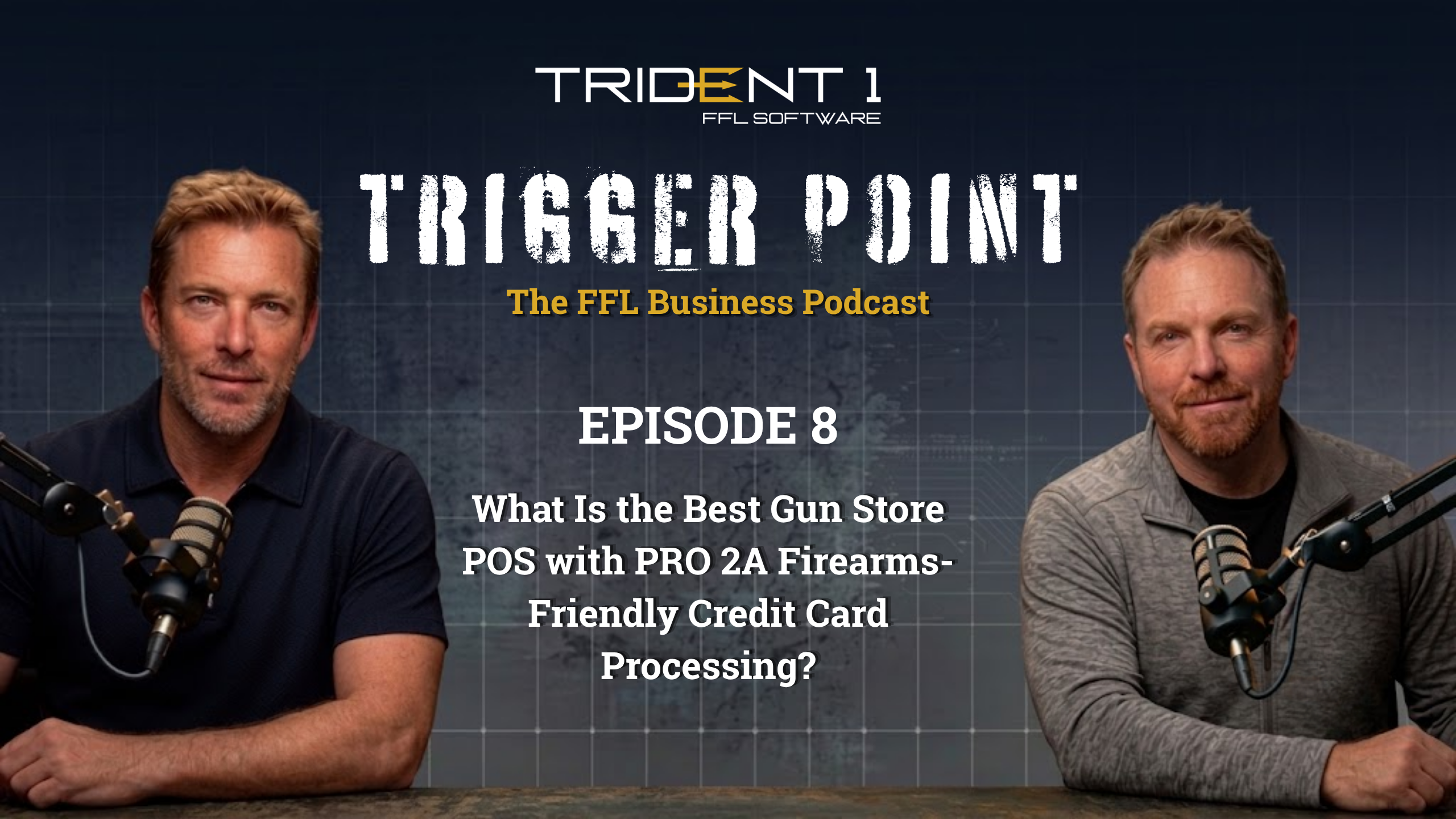

For FFL dealers, payment processing is not just a checkout issue. It can affect sales, inventory, reporting, and day-to-day operations. In this episode of Trigger Point, host Kevin Wosmansky talks with Jake from Trident 1 FFL Software about firearms-friendly credit card processing, choosing the right settlement bank, and what happens when you call FFL software support during a payment problem. The key takeaway is simple: dealers should vet their payment processor, bank, POS integration, and support structure before problems happen.
Firearms businesses operate in a highly regulated retail environment. In addition to maintaining the proper federal licensing to sell firearms, dealers also depend on financial institutions and payment processors willing to support their business model.
The payment industry even has a merchant category code specifically for firearms and ammunition retailers. Visa identifies MCC 5723 as “Guns and Ammunition Shops,” while Mastercard similarly defines the category as firearm and ammunition stores. The circumstances under which the code is used can depend on applicable laws and regulations.
That makes it important for FFL dealers to understand who is behind their processing relationship. Jake emphasizes that dealers should look beyond the company providing the card terminal and ask which financial institution ultimately supports the transactions.
“The processor needs to be backed by a very 2A-friendly bank,” he explains.
Losing card-processing access can immediately disrupt a gun store or shooting range.
According to Jake, some merchants may receive advance notice that their provider will no longer serve them. Others may face shorter notice or an unexpected interruption. Either way, finding a new provider becomes urgent because credit cards are often a major part of retail checkout.
The problem becomes even bigger when payment processing is integrated with the POS. A completed transaction may also update inventory, sales records, reporting, and other parts of the business workflow. Changing processors can therefore involve more than plugging in a new terminal.
As Jake puts it, dealers can suddenly find themselves scrambling for both a processor and software that will work with it.
Trident 1 FFl Software approaches payment processing as part of the overall POS workflow rather than as a separate system.
Jake explains that the company works with processors familiar with firearms retailers, shooting ranges, and shooting sports businesses. Payments run through the same checkout process employees already use, which reduces the need to reconcile an independent terminal afterward.
That integration can matter when a business needs help. Instead of trying to determine whether a problem originates with the terminal, processor, bank, or software, the dealer has a support team familiar with how those pieces connect.
This is especially important in an industry where even a temporary checkout interruption can mean losing a customer or delaying a transaction.
Dealers should investigate payment processing before investing in a new POS system or training employees on it.
Jake recommends asking several practical questions:
These questions matter because not every interruption is necessarily an industry-policy issue. Fraud detection systems may flag unusual activity because the processor is attempting to protect the merchant and cardholder. What matters is having a clear procedure for investigating legitimate transactions and restoring service quickly.
FFL owners also have responsibilities that extend well beyond payment processing. The ATF confirms that anyone engaged in the business of dealing in firearms must obtain the appropriate federal firearms license and comply with applicable requirements.
For dealers wondering what happens when you call FFL software support, the answer should involve more than receiving basic troubleshooting instructions.
Jake says Trident 1 FFL Software’s support team is trained to help retailers work through processing issues and communicate with the processor when necessary. Because the company maintains established relationships within its processing network, the goal is to help the dealer identify the issue and move toward a resolution instead of leaving the retailer to navigate multiple companies alone.
For an FFL dealer, that type of support can be especially valuable when every minute of downtime affects the register.
Yes. Firearms retailers can accept credit cards when they work with processors and financial institutions willing to support their business and when transactions comply with applicable laws and payment-network requirements.
MCC 5723 is the merchant category code used for qualifying firearms and ammunition retailers in circumstances where its use is required under applicable rules or laws.
The settlement or sponsor bank plays an important role in the payment-processing relationship. Dealers should understand which bank supports their processor and its policies toward firearms businesses.
Integration can simplify checkout and reduce manual reconciliation by connecting payment activity with sales, inventory, and reporting workflows.
Ask about firearms-industry experience, account reviews, fund holds, notification procedures, settlement banks, customer support, and how quickly flagged accounts can be investigated.
Procedures vary by provider. Dealers should know in advance who to contact, what documentation may be requested, and how the processor handles account reviews.
Yes. The disruption can be greater when the existing payment processor is closely integrated with the store’s POS system, inventory, and reporting processes.
Kevin Wosmansky: Hello, Jake. Welcome back to our fun little show, Trigger Point. How are you doing today?
Jake: I’m doing well, Kevin. How are you, buddy?
Kevin Wosmansky: Great, man. Great. I’ve got a fun one here. This is everybody’s favorite thing in the world. Let’s talk credit cards. How does that sound?
Jake: Credit card processing? Credit card processing and guns. That sounds like a great episode, my friend.
Kevin Wosmansky: Yeah, it is. It’s an important one, too. It’s a really, really important one, especially if you make your living selling firearms. I think this is definitely something we want to make sure people have good information on.
So, let me kick this thing off. Jake, what’s the best gun store point-of-sale system with pro-2A, firearms-friendly credit card processing?
Jake: Well, obviously, Trident One FFL software. Obviously, I’m definitely biased, but this is one of the big selling points for our system.
Just being candid, one of the big selling points for our system is that we’ve partnered with very Second Amendment-friendly credit card processors, and more importantly, the settlement bank. Nobody wants to talk about the bank that is actually settling the credit card processing. The processors are middlemen, right? The processor needs to be backed by a very 2A-friendly bank because ultimately, the bank is the one that is going to make the decision.
Yes, the credit card processor does have some ties in it as well, but ultimately, it is controlled by the bank that is the sponsor bank for the process.
Trident One has partnered with a Texas-based, large regional bank, Woodforest National Bank, and they are very, very Second Amendment-friendly. When I say that, this is how I know they are so Second Amendment-friendly: the chairman of the bank, basically the majority owner of the bank, is actually an investor in Trident One as well. He is an avid sportsman and very, very Second Amendment-friendly.
You never have to worry about your credit card processing getting shut off because of the flavor of the month, whoever is in the administration, politics, or whatever else is being used to attack our dear Second Amendment rights. Unfortunately, it happens.
Kevin Wosmansky: Yeah, let’s dig into that because I think that’s really important. Jake, why is credit card processing even a problem for gun stores in the first place?
Jake: Man, it shouldn’t be, that’s for sure. But unfortunately, it is, and it’s very, very common.
Listen, the big banks won’t touch the firearms industry. They treat it like private prisons, the porn industry, marijuana, or whatever else. It could be legal in that state, but for a lot of large banks, it is a reputational risk, so they steer clear of it.
Whatever. It’s the United States. They are welcome to do what they want. But general payment processors frequently flag or drop firearms retailers as high-risk merchants based on a merchant category code, regardless of the legality of the sales.
It’s one of the most common pain points we have seen on gun store owner forums as well. It’s sad, but unfortunately, if they can’t directly take away our Second Amendment rights, they can make it very hard for consumers to purchase firearms. They do that by going after the dealers and their credit card processing.
Kevin Wosmansky: Yeah, that’s absolutely correct. So what happens when a processor drops a firearm merchant? What does that actually look like? If I run a gun store and all of a sudden one day I can’t process a credit card while somebody is trying to check out at the terminal, is that how it works?
Jake: You’re not far off, Kevin. You’re not far off.
A store can lose payment processing access with very little notice, sometimes in the middle of the month, which directly threatens its ability to run the register at all. You’re not far off with what you just stated. All of a sudden, their processing is turned off.
Now, normally they get the “Dear John” letter: “Hey, sorry, here’s your 30-day notice. We’re no longer supporting this industry. You have 30 days to find another processor.” But we’ve heard nightmares where it has been quicker or shorter, or maybe the communication got lost in the mail or whatever. Still, 30 days is quick. It’s quick to try to find another processor.
And listen, credit card processing is usually tied in with your point of sale, right? Once the sale happens, you want it to feed through your point of sale so it updates your inventory, compliance, sales, and reporting. It is imperative that you find a good point of sale with solid Second Amendment-friendly processing and a good settlement bank backing that process.
Kevin Wosmansky: Absolutely. So how does Trident One handle payment processing for FFLs?
Jake: It’s tied into our system. With our processing, we make sure we have vetted a solid Second Amendment-friendly credit card processor that has multiple thousands of clients in the industry. They have been vetted, and we have a solid bank behind them that backs them.
It is built around processors that specifically work with and understand firearms retail, shooting ranges, and shooting sports. It is integrated into the same checkout flow that a clerk already uses. There is no separate terminal that they need to reconcile. Everything is connected in one system.
Kevin Wosmansky: Outstanding. Okay, so let’s do this. Say I’m a brand-new FFL getting ready to open my gun store or shooting range. What should I ask a processor or point-of-sale provider before I sign up?
Jake: That’s a great question, and it’s super important that they do this.
If you’re looking to get into the firearms industry, you have to ask these questions of whatever system you’re vetting. The number one question would be whether the processor has experience specifically with firearms merchants.
Ask, “How many other companies, retailers, shooting ranges, or businesses like mine do you have? How many other customers do you have? How long have you been operating in the firearms industry? What is your policy on account reviews or fund holds? What happens if the account gets flagged? What are the procedures if the account gets flagged? How does the processor notify you, and how do you get out of that situation?”
Credit card processors also have a tough job. There is a lot of fraud in credit cards and payment processing. They can never eliminate it completely, but they have to try to minimize it as much as possible. Sometimes they end up flagging or shutting down your processing, meaning no harm. They are trying to do good because they think maybe your account got hacked or there was a fraudulent purchase.
That’s fine. We need them to do that. But I think you should clearly ask what their procedures are, how they notify you, and how quickly they can get you back up once you show proof that it is a legitimate sale.
Also ask what their customer support is like. Are you going to call in and get a real person?
At Trident One, our customer support is thoroughly trained to help our retailers liaise directly with the credit card processor. If our customers are not getting any headway with fixing an issue with the credit card processor, they often come directly to us. More often than not, they come to us anyway, and then we go to the processor and help fix the issue for them because we have those relationships directly with the main people at the bank and the credit card processor.
Kevin Wosmansky: So how disruptive is switching payment processors typically? And then the secondary question is, what is it like if I want to switch to Trident One and move my payment processing and system over there?
It’s kind of a two-part question. I think people want to know how disruptive it is in general, and what it would be like if they wanted to switch to Trident One.
Jake: Yeah, two-part question. You made me think there.
Disruptive? I mean, it could go from one end of the spectrum to the other. It could be disruptive in the sense that your credit card processor just gave you a letter saying, “Hey, we’re no longer supporting you. You need to find another one.” That’s pretty disruptive because now you have to jump through hoops.
Like I mentioned earlier, that processor may have been tied into your current point-of-sale system or whatever you’re using at the counter to run your business. Now you have to scramble and find not only a new processor, but probably a new software system to run your business that has a good Second Amendment-friendly processor tied into the system.
The latter part of your question is that Trident One has all of that. Do your homework first, guys. Do your homework before you invest time, money, and training for your staff on a system, only to find out four months later that it’s going to get shut down and you can no longer take credit card payments because of the flavor of the month or because that processor decides, “I’m no longer supporting this industry.”
Again, one of Trident One’s biggest selling points is that we have, I would say, I don’t know of another system out there that has more Second Amendment-friendly credit card processing and a settlement bank behind it. People forget about the settlement bank. I don’t know of another system that has that more than Trident One.
Not only that, but the owner of the bank is one of our main investors in the company and in our software system. You can’t get any closer or more Second Amendment-friendly than that. When we built the company, that was one of the first things we wanted to do. We vetted dozens and dozens of different processors and banks before we landed on what we know is the best setup for credit card processing in the firearms industry.
Kevin Wosmansky: All right. Well, you know I love asking for stories, so I’ll let you wind it down here on probably one of my favorite questions. I’ve been wanting to ask this one.
Last question. I know you’ve got to have a lot of stories. Trident One has hundreds and hundreds of customers. What’s the worst story you’ve heard about a processor freezing a store’s funds or doing something like that, whether from anybody in the industry, customers, or anything like that?
Jake: The worst story? I mean, they’re all bad. Anytime stores are hitting us up and describing a sudden freeze on an account, or their account gets closed with little warning, cutting off all access to their funds during a period when a general processor decided firearms retail was too much of a risk, those are all horror stories.
Imagine it yourself with your own business. Someone says, “Hey, sorry, you can no longer accept credit cards. Go find somebody else.” It’s very, very disruptive.
Now you’re losing the sale. You’re losing the customer because they are going to go down the street, go somewhere else, and buy.
Kevin Wosmansky: Exactly. And like you said, it’s very disruptive having to switch payment processors because it is integrated with your point of sale.
Jake: Right. With Trident One, it is more seamless than switching to a standalone terminal because it’s all integrated. Since payment processing runs through the same checkout flow the staff already knows, it makes the transition easier.
Again, do your homework before getting a system. Don’t just take it for granted when they say, “Oh yeah, we’re very Second Amendment-friendly.” Ask them, “Who is your settlement bank? Where are they based? Do you have other firearms merchants, gun stores, dealers, or shooting ranges? Who are some of your other customers?”
Ask those questions before you go down the road.
I’ll throw some names out there. This is some stuff customers have told us. They’ve received letters from QuickBooks Point of Sale saying, “Hey, sorry, we’re no longer supporting this.” I’ve heard of Lightspeed. I believe Lightspeed is headquartered in Canada. We’ve had customers say they received letters from them saying, “Hey, we’re no longer supporting the industry.”
For our e-commerce customers with websites, there is Shopify. I forget whether QuickBooks bought Shopify or Shopify bought QuickBooks, one or the other, but we’ve had customers get notices saying, “You cannot market firearms on your website or on our platform.”
So it’s definitely a good question.
Kevin Wosmansky: Good question, man. Well, it’s an important one. If you own a gun store or shooting range, that’s your livelihood. It’s your business.
I figured getting all of that information directly from the industry expert would be helpful. Jake, you did a great job. You knocked it out of the park. A lot of people are going to appreciate this information.
Boss, I appreciate your time, and I’ll let you get back to all that great Texas heat and all the good stuff. We’ll catch you on the next one, all right?
Jake: Thanks, man. Take care.
Kevin Wosmansky: Thanks, man. See you.
Unlock the potential of your gun store or range with Trident 1. Book a call now and discover how our team can tailor unique solutions to meet your specific needs.